

QuickBooks Desktop cannot install correctly without three specific Windows software components working properly on the computer: Microsoft .NET Framework, MSXML, and Microsoft Visual C++ Redistributable files. These three components are not part of QuickBooks itself; they are Microsoft programs that Windows provides and that QuickBooks depends on to run its setup process, register its program files, and read its license and registration data. A damaged, missing, or incorrectly registered version of any one of them stops the QuickBooks installation and produces a specific error code.
Intuit’s official documentation confirms this relationship directly: QuickBooks Desktop uses Microsoft components like .NET Framework, MSXML, and C++ to run the program properly on a Windows computer. Errors caused by damage to these components appear as installation error codes including 1603, 1722, 1935, 1904, and error messages such as “There was a problem installing Microsoft .NET Framework” or “QuickBooks had a problem accessing this registration file. Make sure MSXML 4 is installed correctly.” Each message identifies which component failed and why the installation stopped.
The good news is that all three components are repairable without reinstalling Windows. Intuit provides the QuickBooks Install Diagnostic Tool specifically to detect and fix these component problems automatically. For cases where the automated tool is not enough, each component has a manual repair process that takes 5 to 20 minutes. This article covers what each component does, every error it produces when damaged, and every fix automated and manual applied in the correct sequence.
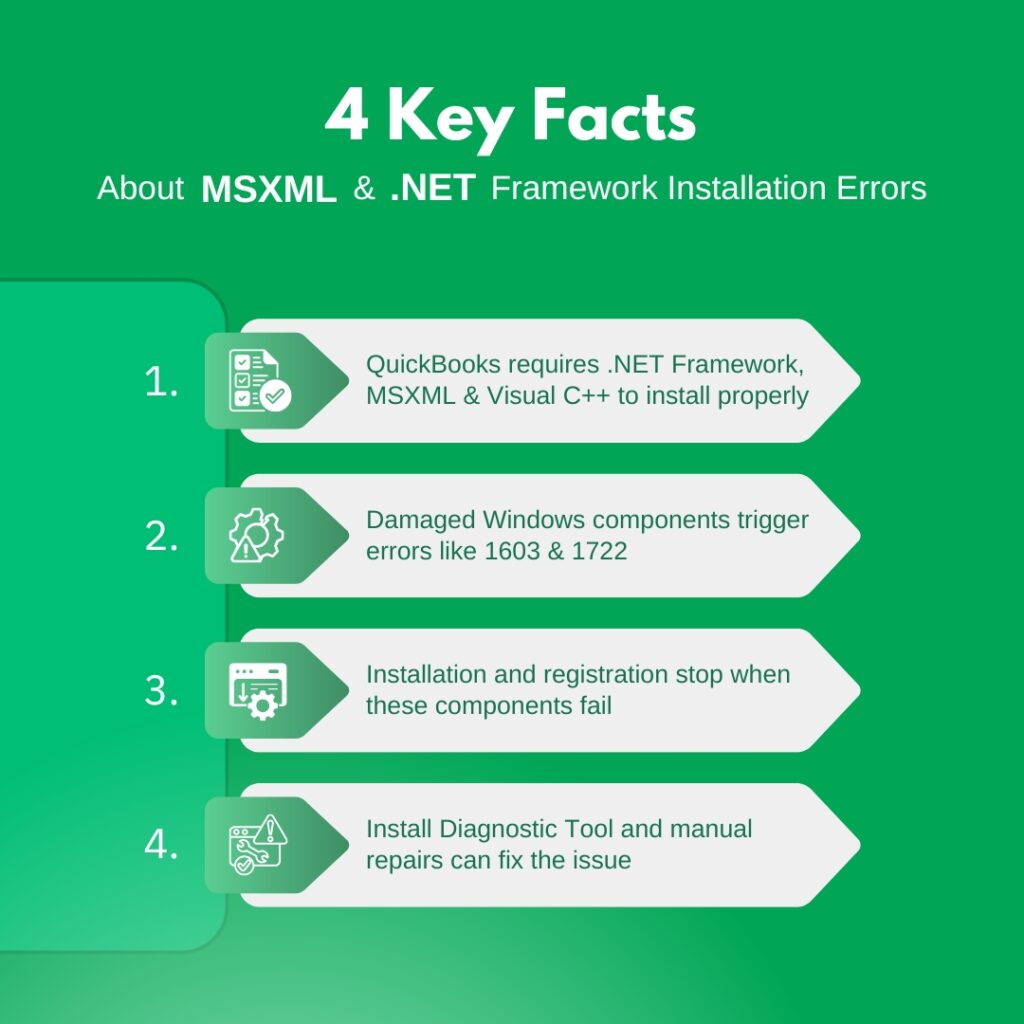
Table of Contents
What Each Component Does and Why QuickBooks Need It?
- Microsoft .NET Framework: The Program’s Running Environment
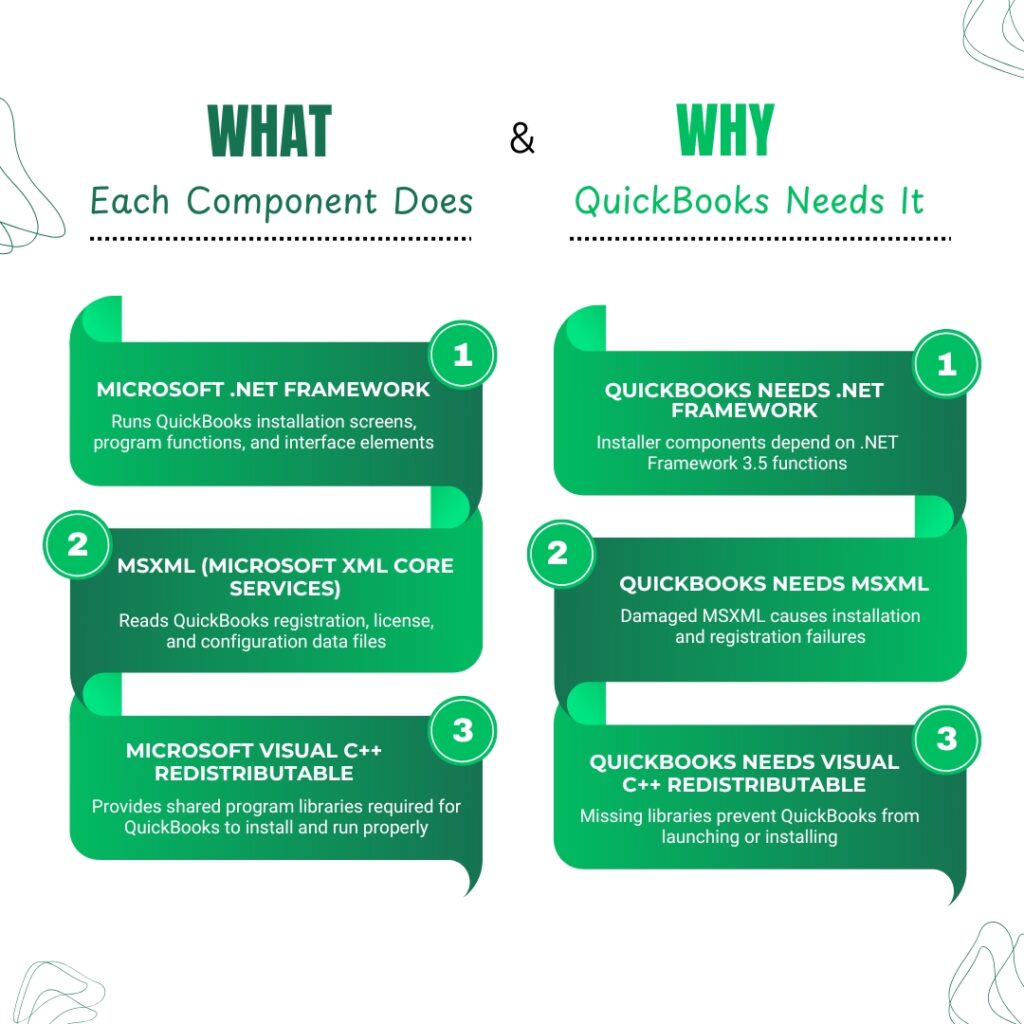
Microsoft .NET Framework is a software layer that Microsoft builds into Windows. A software layer is a set of pre-built tools and functions that application developers use instead of building those functions from scratch. QuickBooks uses .NET Framework to run its installation screens, register its program files during setup, manage its internal calculations, and handle the program’s graphical interface elements like buttons, menus, and data entry fields. The QuickBooks installer calls .NET Framework functions hundreds of times during a single installation process.
Different QuickBooks versions require different .NET Framework versions. QuickBooks Desktop 2022 and later requires .NET Framework 4.8. The installer also requires .NET Framework 3.5 (which includes .NET 2.0 and 3.0) because some installer components were written for earlier framework versions. On Windows 11, .NET Framework 4.8 is built in, but .NET Framework 3.5 is not enabled by default; it must be manually turned on through Windows Features before QuickBooks can install successfully.
When .NET Framework is damaged or the wrong version is present, the QuickBooks installer fails at the specific step where it calls a .NET function. The installer reports this as Error 1603 with the message “There was a problem installing Microsoft .NET Framework,” or as Error 1935 with the message “QuickBooks Error Code 1935: .NET Framework configuration is required.” Both messages confirm .NET Framework is the failed component.
- MSXML: The Data Reading Component
MSXML stands for Microsoft XML Core Services. XML Extensible Markup Language is a structured text format that programs use to organize and store data in a way that both humans and other programs can read. QuickBooks stores its registration data, license information, and configuration settings in XML-formatted files. MSXML is the Windows component QuickBooks uses to read and write these XML files during installation and during normal operation.
Intuit’s official MSXML repair documentation explains the dependency precisely: “QuickBooks Desktop accesses the QBRegistration.dat file during installation. Because the file is in XML format, the setup program uses MSXML 4 to read the file. If MSXML 4 is either not installed or damaged, the file cannot be read.” The QBRegistration.dat file is the registration data file stored at C:\ProgramData\Common Files\Intuit\QuickBooks\QBRegistration.dat. A missing or damaged MSXML component means QuickBooks cannot read its own registration data during installation, causing the process to fail.
Intuit’s documentation lists the specific error messages that appear when MSXML is the problem: “QuickBooks had a problem accessing this registration file. Make sure MSXML 4 is installed correctly: C:\Documents and Settings\All Users\Application Data\COMMON FILES\Intuit\QuickBooks\QBRegistration.dat,””An unrecoverable error has occurred. Exception: msxml could not create an instance,” and “The install process stays at ‘Installing MSXML 4.0’ and does not continue.” Each of these messages points directly to MSXML as the component requiring repair.
- Microsoft Visual C++ Redistributable: The Shared Program Libraries
Microsoft Visual C++ Redistributable files are sets of shared program libraries collections of pre-built code that programs built with Microsoft’s Visual C++ development tools need to run. Most major Windows programs, including QuickBooks, are built using Visual C++ tools. Instead of each program carrying its own private copy of these shared libraries, Windows maintains centrally installed versions that all programs share. QuickBooks uses these shared libraries for core operations including file access, memory management, and program startup routines.
Multiple versions of Visual C++ Redistributable files exist on most Windows computers: versions from 2010, 2012, 2013, and 2015–2022. QuickBooks requires specific versions to be intact. A damaged or missing C++ Redistributable set produces error messages including: “Microsoft Visual C++ Debug Error Program: C:\Program Files\Intuit\QuickBooks [Year]\QBW32.exe Abnormal Program Termination” and “Application failed to start because side by side configuration is incorrect.” The “side by side” phrase refers to the Windows Side-by-Side (SxS) component system, the mechanism Windows uses to manage multiple versions of shared libraries simultaneously.
Error Code Reference: Which Component Each Error Points To
Match the exact error message or code showing on screen to identify which component needs repair before applying any fix.
| Error Code or Message | Component Responsible | Plain-English Meaning | First Fix to Apply |
|---|---|---|---|
| Error 1603 – “There was a problem installing Microsoft .NET Framework” | .NET Framework | .NET Framework installation failed during the QuickBooks setup process | Fix 1: Install Diagnostic Tool; Fix 3A if still unresolved |
| Error 1935 – “.NET Framework configuration is required” or “An error took place due to assembly installation” | .NET Framework | A required .NET assembly (a pre-built code block) could not be installed | Fix 1: Install Diagnostic Tool; Fix 3A manual .NET repair |
| “QuickBooks had a problem accessing this registration file. Make sure MSXML 4 is installed correctly” | MSXML | MSXML 4 is missing or damaged; QuickBooks cannot read QBRegistration.dat | Fix 1: Install Diagnostic Tool; Fix 4A MSXML re-registration |
| “An unrecoverable error has occurred. Exception msxml could not cocreate instance” | MSXML | MSXML cannot create the object it needs to process the XML registration file | Fix 4A: Re-register MSXML via Command Prompt |
| “The install process stays at ‘Installing MSXML 4.0’ and does not continue” | MSXML | MSXML 4 installation is looping or blocked during the QuickBooks setup step | Fix 4B: Uninstall and reinstall MSXML manually from Microsoft |
| Error 1722 – “A program run as part of this setup did not finish as expected” | .NET Framework or MSXML | A custom helper program the installer ran likely a .NET or MSXML setup task failed | Fix 1: Install Diagnostic Tool; Fix 2: Selective Startup |
| “Microsoft Visual C++ Debug Error: QBW32.exe Abnormal Program Termination” | Visual C++ Redistributable | QuickBooks’ main program file cannot start because the C++ libraries it needs are damaged | Fix 1: Install Diagnostic Tool; Fix 5: Repair C++ via Control Panel |
| “Application failed to start because side by side configuration is incorrect” | Visual C++ Redistributable | The C++ Side-by-Side shared library registry entry is broken or pointing to a wrong version | Fix 5: Repair all Visual C++ Redistributable entries in Programs and Features |
| C=343 – “Filename.dll is not an executable file” or “No registration helper is registered for this file type” | MSXML | MSXML dll file exists but is not registered with Windows so QuickBooks cannot call it | Fix 4A: Re-register MSXML6.dll via administrator Command Prompt |
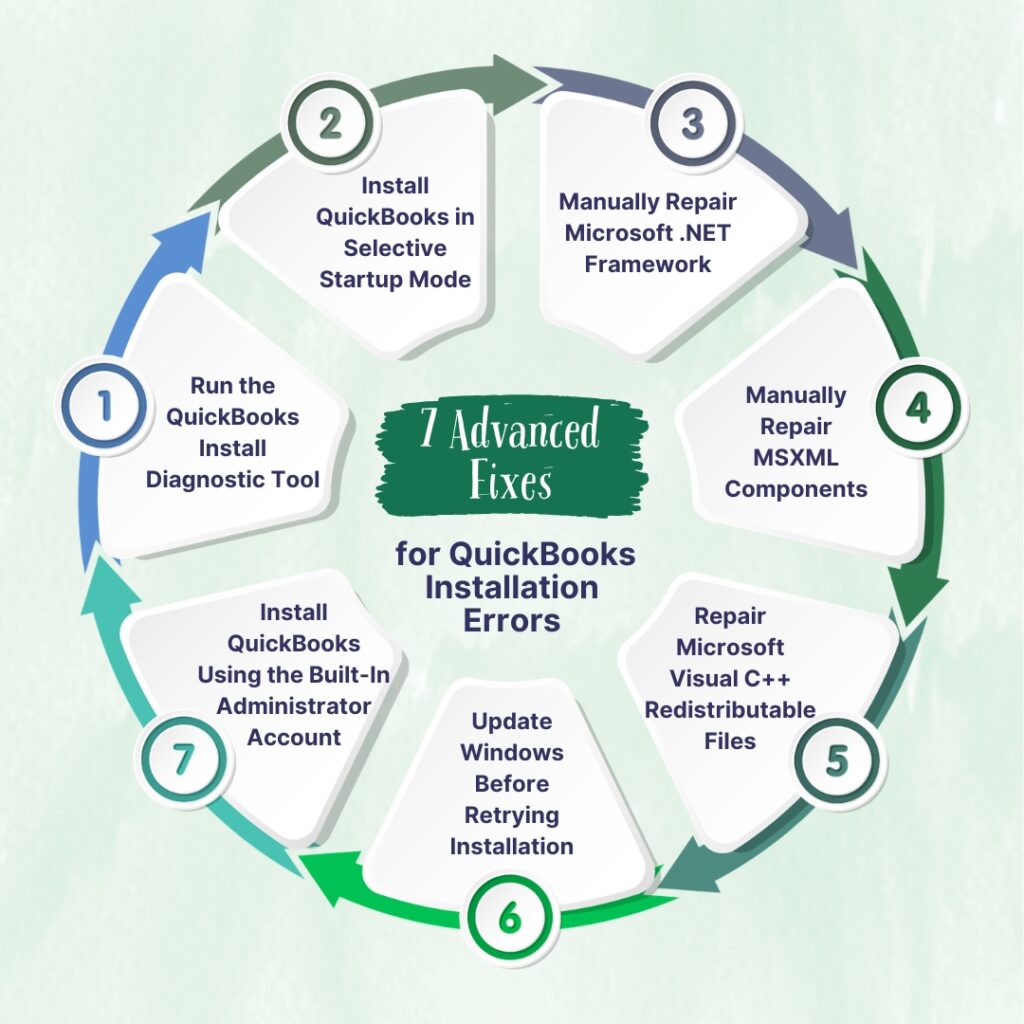
Fix 1: Run the QuickBooks Install Diagnostic Tool (Start Here for Every Error)
What Does This Tool Do?
The QuickBooks Install Diagnostic Tool is a free utility from Intuit that automatically detects and repairs damaged or missing .NET Framework, MSXML, and Visual C++ components in one automated process. Intuit designed this tool specifically because these three components are the primary cause of QuickBooks installation failures. The tool does not require the user to know which component is damaged; it checks all three, identifies which ones need repair, downloads the correct versions, and installs them without any manual steps.
The tool is accessed through the QuickBooks Tool Hub Intuit’s free all-in-one repair application. Intuit’s documentation confirms the tool “automatically identifies and resolves installation issues that can prevent you from installing or opening QuickBooks on your computer.” The entire process takes up to 20 minutes, and the computer must be restarted after the tool finishes before QuickBooks installation is retried. A strong, stable internet connection is required throughout the process because the tool downloads the correct component versions from Microsoft’s servers.
Step-by-Step Instructions
Download the QuickBooks Tool Hub version 1.6.0.8 from Intuit’s official support page. Open the downloaded QuickBooksToolHub.exe file and follow the on-screen prompts to install it. Open the QuickBooks Tool Hub. Click Installation Issues in the left menu. Click QuickBooks Install Diagnostic Tool. Allow it to run without closing it or interrupting it it can take up to 20 minutes. The process downloads and verifies each component individually, so it requires patience. Do not shut down the computer while it is running. Restart the computer when the tool reports it has finished. Retry the QuickBooks installation.
If the installation fails again after one run, run the Install Diagnostic Tool a second time before moving to manual fixes. Some component repairs require a first pass to install a dependency before a second pass can repair the component itself. Running it twice resolves installation failures that a single run could not complete. This second-run approach is confirmed in Intuit’s own support documentation as a valid step before manual repairs.
Fix 2: Install QuickBooks in Selective Startup Mode
Why Selective Startup Matters for Component Errors?
Antivirus programs and background applications sometimes block the Install Diagnostic Tool and the QuickBooks installer from writing repaired component files to protected Windows folders. A blocked component write produces the same MSXML and .NET Framework errors as a genuinely missing component, because from QuickBooks’ perspective, the component is not accessible either way. Selective Startup mode, a Windows state where only essential Microsoft services run, removes all third-party programs from memory, including antivirus software, during the installation and repair process.
This fix is the correct next step when the Install Diagnostic Tool ran successfully but the installation still failed, or when the Install Diagnostic Tool itself showed an error during its run. The documented cause in these cases is that antivirus real-time protection intercepted either the component download or the component write operation. Disabling all non-Microsoft services for the duration of the installation eliminates this interference.
Press Windows + R, type msconfig, and press Enter. Click the General tab. Select Selective Startup. Uncheck Load Startup Items. Click the Services tab. Check Hide All Microsoft Services. Click Disable All. Click Apply > OK. Click Restart. After the computer restarts in Selective Startup mode, run the Install Diagnostic Tool again, then run the QuickBooks installer as administrator. After QuickBooks installs successfully, return to msconfig, select Normal Startup, click Apply > OK, and restart the computer.
Fix 3: Manually Repair Microsoft .NET Framework
Fix 3A: Enable .NET Framework Through Windows Features
Windows 11 does not have .NET Framework 3.5 enabled by default. QuickBooks’ installer requires .NET Framework 3.5 alongside .NET Framework 4.8 because some installer components were written for the older 3.5 version. A QuickBooks installation that fails with Error 1935 or stalls during the .NET setup step on a Windows 11 machine is almost always caused by the missing 3.5 version. Enabling it through Windows Features is a five-minute fix that resolves this specific cause without downloading any additional software.
Press Windows + R, type control panel, and press Enter. Go to Programs > Turn Windows Features On or Off. Find .NET Framework 3.5 (includes .NET 2.0 and 3.0) in the list. Check the box next to it if it is unchecked. Also confirm that .NET Framework 4.8 Advanced Services is checked. Click OK. Windows downloads and enables both components. Restart the computer when the process finishes. Retry the QuickBooks installation.
Fix 3B: Repair a Damaged .NET Framework 4.8 Installation
A .NET Framework 4.8 installation that is already enabled but damaged produces errors at a different point than a missing 3.5 installation; it causes QuickBooks to fail during steps that register program files rather than during the initial setup screen loading. Repairing .NET 4.8 through Windows Features removes and reinstalls it cleanly without affecting the rest of Windows.
Open Control Panel > Programs > Turn Windows Features On or Off. Find .NET Framework 4.8 Advanced Services in the list. Uncheck it and click OK. Restart the computer. Open the same Windows Features panel, check .NET Framework 4.8 Advanced Services again, and click OK. Windows reinstalls it from scratch. Restart the computer again after the reinstall completes and retry the QuickBooks installation.
Fix 3C: Use the .NET Framework Repair Tool From Microsoft
Microsoft publishes a dedicated .NET Framework Repair Tool for situations where enabling or re-enabling .NET through Windows Features does not repair the damage. This tool is available from Microsoft’s official download page and specifically targets .NET Framework installation errors that Windows Features cannot resolve on its own. It detects corrupted .NET Framework files, removes them, and replaces them with working versions. Download the .NET Framework Repair Tool from Microsoft’s official download page, run it as administrator, and follow the on-screen steps. Restart the computer and retry the QuickBooks installation after it completes.
Fix 4: Manually Repair MSXML
Why MSXML Requires a Specific Repair Approach on 64-Bit Windows?
On a 64-bit Windows system the type of Windows required by QuickBooks 2022 and later MSXML must be registered using a specific compatibility folder called SysWOW64. SysWOW64 is a folder inside the Windows directory (C:\Windows\SysWOW64) that handles running 32-bit programs and components on a 64-bit operating system. MSXML is a 32-bit component that must run through this compatibility layer. Registering MSXML from the standard Windows system folder (C:\Windows\System32) on a 64-bit computer does not work correctly and produces an error message: “No registration helper is registered for this file type.”
Intuit’s official MSXML repair documentation specifies this exact approach: “64-Bit operating system, register MSXML with the following steps: Select the Windows Start menu and type cmd. Right-click cmd and select Run as Administrator. At the C: prompt, enter cd\windows\syswow64. Type regsvr32 MSXML6.dll and press Enter.” The regsvr32 command registers a .dll file a shared program library with Windows so that other programs can find and use it. Running this command in the SysWOW64 folder, not the System32 folder, is the critical detail that makes the repair work correctly on 64-bit Windows.
Fix 4A: Re-Register MSXML6.dll on a 64-Bit Windows System
Press Windows, type cmd, right-click Command Prompt, and select Run as administrator. Click Yes when Windows asks for permission. In the Command Prompt window, type: cd\windows\syswow64 and press Enter. This changes the working location to the SysWOW64 folder. Then type: regsvr32 MSXML6.dll and press Enter. A pop-up message reading “DllRegisterServer in MSXML6.dll succeeded” confirms the registration worked. Close Command Prompt. Retry the QuickBooks installation.
If the MSXML6.dll registration produces an error instead of the success message, try registering the other MSXML versions that QuickBooks also uses. In the same administrator Command Prompt, still in the SysWOW64 folder, type each of these commands separately and press Enter after each: regsvr32 msxml.dll, then regsvr32 msxml2.dll, then regsvr32 msxml3.dll, then regsvr32 msxml4.dll. Each successful registration shows the “DllRegisterServer… succeeded” message. Close Command Prompt and retry the QuickBooks installation after all registrations complete.
Fix 4B: Uninstall and Reinstall MSXML for an Installation That Stays Frozen at ‘Installing MSXML 4.0’
A QuickBooks installation that stays frozen at the ‘Installing MSXML 4.0’ progress step without advancing indicates that the MSXML 4 installer is either already running from a previous failed attempt or that the MSXML component is in a partially installed state that neither the registration command nor the Install Diagnostic Tool can repair. The fix requires removing MSXML 4 through the Control Panel and reinstalling it manually from Microsoft.
Open Control Panel > Programs > Programs and Features. Look for MSXML 4.0 SP2 or MSXML 4.0 SP3 in the list. Right-click it and select Uninstall. Restart the computer after the uninstall completes. Download the MSXML 4.0 installer from Microsoft’s official download center by searching for “MSXML 4.0 Service Pack 3.” Run the downloaded installer as administrator. Restart the computer after MSXML 4 reinstalls. Retry the QuickBooks installation.
Fix 5: Repair Microsoft Visual C++ Redistributable Files
Why the C++ Error Message Points to a Specific Fix?
The Visual C++ error message “Application failed to start because side by side configuration is incorrect” appears when the Windows Side-by-Side (SxS) component system the mechanism Windows uses to manage multiple versions of shared libraries has a broken registry entry that points QuickBooks to the wrong version of a required library. The Windows SxS system stores multiple versions of shared libraries simultaneously so different programs that need different versions can each use the correct one. A broken SxS registry entry breaks this version selection, and QuickBooks starts but immediately fails because it loaded the wrong library version.
The “QBw32.exe Abnormal Program Termination” error produces the same underlying cause but manifests during program startup rather than during installation. Both errors are resolved the same way: repair each installed Visual C++ Redistributable entry through the Control Panel, which resets the SxS registry entries to point to the correct library locations.
Open Control Panel > Programs > Programs and Features. Look for all entries named Microsoft Visual C++ Redistributable in the list there may be multiple entries for different years (2010, 2012, 2013, 2015–2022, 2022). Right-click each one and select Repair. If any entry does not have a Repair option, uninstall it and download the latest version of that specific C++ Redistributable from Microsoft’s official download page. Repair or reinstall each version present. Restart the computer after all repairs are complete. Retry the QuickBooks installation.
Fix 6: Update Windows Before Retrying the Installation
Why Windows Updates Fix Component Errors?
Windows updates include updated versions of .NET Framework, MSXML, and Visual C++ Redistributable files that fix known bugs in those components. A computer that has skipped Windows updates for weeks or months may have versions of these components that contain bugs Intuit’s installer is not compatible with. Installing all pending Windows updates ensures these components are at the most recent, most stable versions before QuickBooks installation is attempted. Confirmed in multiple troubleshooting resources: “Install the latest Windows updates, including .NET Framework, MSXML, and C++ Redistributable” is listed as a core preventive step for all three component-related QuickBooks installation errors.
Go to Windows Settings > Windows Update > Check for Updates. Install all available updates. Restart the computer after updates are installed. Check for updates again to catch any secondary updates that were not available in the first round. After all updates are installed and the computer has been restarted, run the QuickBooks Install Diagnostic Tool (Fix 1) once more before retrying the QuickBooks installation. The combination of updated Windows components and a Diagnostic Tool run after the update produces the highest success rate for component-related installation errors.
Fix 7: Install QuickBooks Using the Built-In Administrator Account
When Standard Administrator Rights Are Not Enough?
Windows 11 has two types of administrator accounts: the standard administrator account that most users work from, and the built-in Administrator account that Windows creates automatically as a hidden account. The built-in Administrator account bypasses User Account Control (UAC) the Windows security feature that asks for permission before allowing programs to make changes to the computer. Even when a standard administrator accepts the UAC prompt, some protected Windows folders and registry locations remain restricted. The built-in Administrator account has unrestricted access to all Windows locations, which the QuickBooks installer needs to write .NET, MSXML, and C++ component files to protected system directories.
Error 1935 the assembly installation error is specifically documented as occurring when the user account running the installation does not have full write access to the Windows assembly folders where .NET components are stored. Installing from the built-in Administrator account eliminates this access restriction and allows the installer to write all component files without UAC interference.
Press Windows, type cmd, right-click Command Prompt, and select Run as administrator. Type: net user administrator /active:yes and press Enter. A message reading “The command completed successfully” confirms the account is now active. Click Start > sign out of the current account > select Administrator on the login screen (no password required). Log in. Right-click the QuickBooks installer and select Run as administrator. After installation completes successfully, return to the standard account. Open an administrator Command Prompt and type: net user administrator /active:no to disable the built-in account again.
All QuickBooks Error Fixes at a Glance
| Fix | Component It Repairs | Time Required | When to Use It |
|---|---|---|---|
| Fix 1: QuickBooks Install Diagnostic Tool | .NET Framework, MSXML, and Visual C++ all three at once | 15–20 min | First fix for all MSXML and .NET errors; run twice if needed |
| Fix 2: Selective Startup mode installation | Removes antivirus and background app interference during repair | 15 min | When Fix 1 ran but installation still failed |
| Fix 3A: Enable .NET 3.5 via Windows Features | .NET Framework 3.5 missing on Windows 11 | 5–10 min | When the installer fails during early setup on Windows 11 |
| Fix 3B: Disable and re-enable .NET 4.8 | Damaged .NET Framework 4.8 | 10 min | When Error 1935 or 1603 appears with .NET 4.8 reference |
| Fix 3C: Microsoft .NET Repair Tool | Deeply damaged .NET Framework that Windows Features cannot repair | 10–15 min | After Fix 3A and 3B did not resolve the error |
| Fix 4A: Re-register MSXML6.dll (64-bit) | Unregistered MSXML on 64-bit Windows 11 | 5 min | When MSXML error message appears or installation stalls at MSXML step |
| Fix 4B: Uninstall and reinstall MSXML 4 | Partially installed or corrupted MSXML 4 state | 10–15 min | When installation freezes specifically at ‘Installing MSXML 4.0’ |
| Fix 5: Repair Visual C++ Redistributable | Damaged or broken C++ shared library registry entries | 10 min | When C++ error message or QBW32.exe error appears |
| Fix 6: Install Windows Updates | Outdated or buggy component versions from skipped updates | 20–40 min | Before any installation attempt; always the right starting point |
| Fix 7: Built-in Administrator account | UAC permission restriction blocking component writes | 10 min | When Error 1935 persists after all other fixes |
Multi-Computer Environments: Applying QuickBooks Error Fixes Across Workstations
In a business with multiple computers running QuickBooks Desktop, MSXML and .NET errors that appear on every workstation during the same update point to a shared cause rather than individual computer problems. A Windows update pushed to all computers on the same day that changed a shared component produces the same error across all machines simultaneously. The Install Diagnostic Tool must be run on each affected computer individually; it cannot be run from a central server and applied to workstations remotely, because component registration is local to each computer’s Windows registry.
A practical approach for multi-computer environments: run the Install Diagnostic Tool on one workstation first and confirm the installation succeeds before applying the same fix sequence to the remaining computers. This confirms the fix is effective before committing the time to apply it across the entire office. Each computer must be restarted individually after the Diagnostic Tool runs; a centralized restart does not complete the component repair process for individual workstations.
All computers in a multi-user QuickBooks environment must also run the same QuickBooks version and release number. A workstation where the component repair allowed QuickBooks 2024 R15 to install while the server computer still runs 2024 R12 creates a version mismatch that produces multi-user connection errors. After completing the component repairs and QuickBooks installation on each workstation, confirm all computers show the same release number by pressing F2 or Ctrl + 1 inside QuickBooks on each machine.
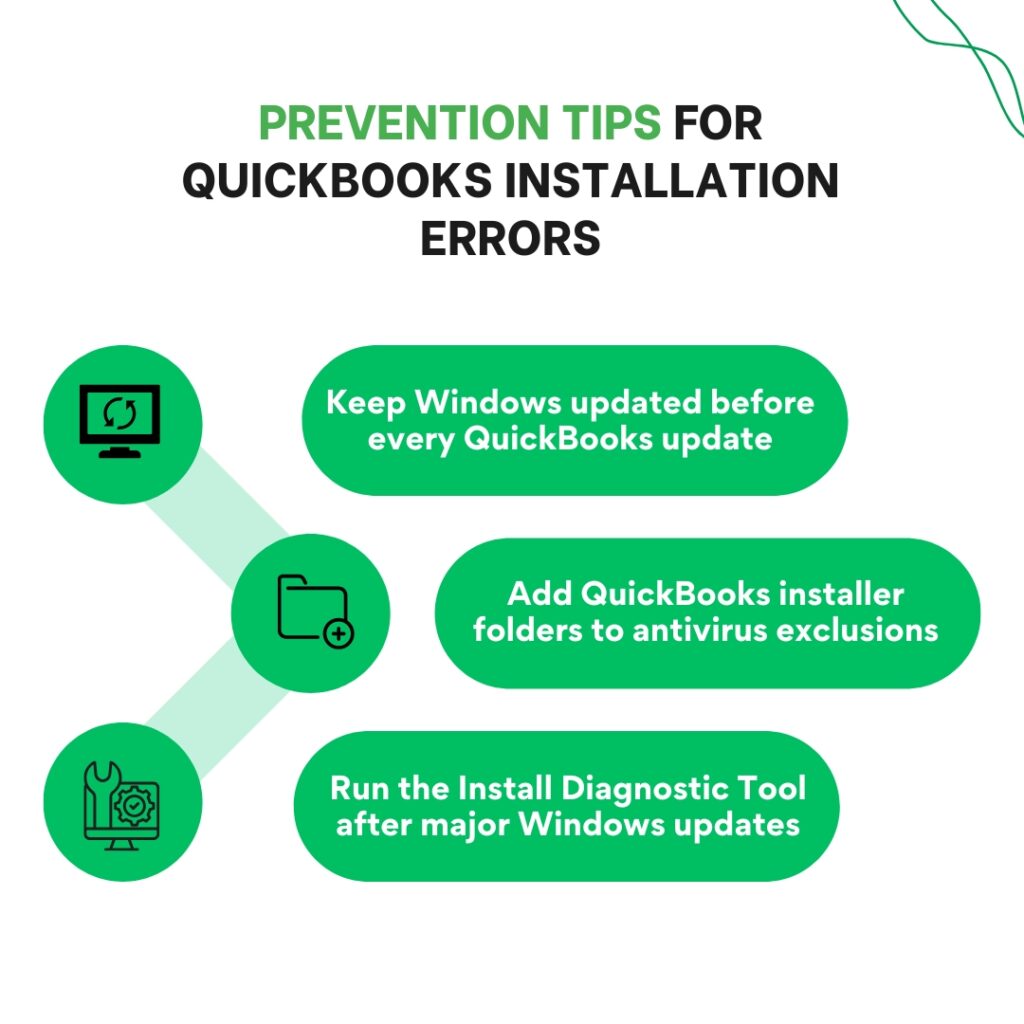
QuickBooks Prevention: Stop Component Errors From Recurring
- Keep Windows Updated Before Every QuickBooks Update
Windows updates include improved versions of .NET Framework, MSXML, and Visual C++ files. A computer that has pending Windows updates when a QuickBooks update installs runs the QuickBooks update against older component versions that may not be fully compatible. Installing all pending Windows updates through Settings > Windows Update > Check for Updates before every QuickBooks update, and restarting the computer before running the QuickBooks update, ensures the components are current when the update runs. This eliminates the most common cause of component errors appearing specifically during QuickBooks update patches.
- Add QuickBooks Installer Folders to Antivirus Exclusions
Antivirus real-time protection intercepts the QuickBooks installer’s attempts to write .NET, MSXML, and C++ component files to protected Windows folders. Each intercepted write produces the same error as a genuinely damaged component, because from QuickBooks’ perspective, the write did not complete. Adding the QuickBooks installation folder (C:\Program Files\Intuit\QuickBooks [Year]) and the Windows Temp folder (C:\Windows\Temp) to the antivirus exclusion list stops real-time scanning from blocking these writes during installation. Re-enable full scanning after the installation completes.
- Run the Install Diagnostic Tool After Every Major Windows Update
A major Windows update that changes .NET Framework, MSXML, or Visual C++ components can silently break the versions QuickBooks is using, without producing an error until the next time QuickBooks tries to perform an operation that calls those components. Running the Install Diagnostic Tool from the QuickBooks Tool Hub after every major Windows update (Tool Hub > Installation Issues > QuickBooks Install Diagnostic Tool) proactively repairs any component changes the Windows update introduced. This preventive run takes 20 minutes and eliminates the scenario where component damage accumulates unnoticed until QuickBooks crashes or a subsequent update fails.
Conclusion
MSXML and .NET Framework errors during QuickBooks installation all come from the same root cause: one or more of the three Windows components QuickBooks depends on .NET Framework, MSXML, and Visual C++ is damaged, missing, or incorrectly registered on the computer. Each error code and each error message identifies which component failed and at which step of the installation process. Error 1935 or 1603 with a .NET message points to .NET Framework. The QBRegistration.dat access error points to MSXML. The QBW32.exe Abnormal Program Termination or side-by-side configuration error points to Visual C++.
Intuit’s QuickBooks Install Diagnostic Tool resolves all three component types automatically and is always the correct first step. For cases where the automated tool is not sufficient because antivirus blocked the tool’s component writes, because .NET 3.5 is specifically not enabled on Windows 11, or because MSXML needs to be manually re-registered on a 64-bit system each component has a specific manual repair path that takes 5 to 20 minutes. Applying the manual repair for the specific component identified by the error message, combined with a Selective Startup mode installation that removes antivirus interference, resolves the overwhelming majority of component-related installation failures.
Intuit’s QuickBooks Tool Hub version 1.6.0.8 free from Intuit’s official support page contains the Install Diagnostic Tool that handles the automated component repair. Keeping the Tool Hub installed on every computer running QuickBooks Desktop means the primary component repair tool is available immediately when a component error appears during any future installation or update.
Frequently Asked Questions
1. The Install Diagnostic Tool ran but the same MSXML error appears on retry. Does the tool need to be run again or is a manual fix required?
Run the Install Diagnostic Tool a second time before moving to manual fixes. Intuit’s documentation and confirmed community forum responses support running the tool twice, because the first run repairs some component dependencies that the second run then uses to complete the remaining repairs.
If the error continues after two runs, the MSXML component is in a state the automated tool cannot repair which is when the manual MSXML6.dll re-registration command (Fix 4A in this article) is the correct next step. Type cd\windows\syswow64 in an administrator Command Prompt, then type regsvr32 MSXML6.dll and press Enter. The “DllRegisterServer in MSXML6.dll succeeded” message confirms the registration completed successfully.
2. Error 1935 appeared with the message about assembly installation during QuickBooks setup on Windows 11. Why is this error specific to Windows 11?
Error 1935 with the assembly installation message on Windows 11 is most commonly caused by .NET Framework 3.5 not being enabled. Windows 11 ships with .NET Framework 4.8 built in but does not enable .NET Framework 3.5 by default. QuickBooks’ installer requires 3.5 alongside 4.8 because older installer components were written for the 3.5 framework.
The installer reaches the step that calls a 3.5 framework function, finds it missing, and stops with Error 1935. Enabling .NET Framework 3.5 through Control Panel > Programs > Turn Windows Features On or Off resolves this specific Windows 11 manifestation of Error 1935 in most cases. This fix takes five minutes and is confirmed by Intuit’s troubleshooting documentation as the correct starting point for .NET-related Error 1935 on Windows 11.
3. The installation freezes at the ‘Installing MSXML 4.0’ progress bar for more than 30 minutes. Is waiting longer the answer?
An installation frozen at ‘Installing MSXML 4.0’ for more than 10 to 15 minutes is not going to complete on its own it is stuck in a loop or blocked state. The correct action is to close the installer through Task Manager (Ctrl + Shift + Esc > find the QuickBooks setup process > End Task), restart the computer, and then remove MSXML 4 from the Control Panel (Programs and Features > find Microsoft XML Core Services 4.0 SP2 or SP3 > Uninstall).
After MSXML 4 is removed and the computer is restarted, download the MSXML 4.0 SP3 installer from Microsoft’s official download page and install it manually. After MSXML 4 is installed cleanly, retry the QuickBooks installation it will no longer freeze at that step because MSXML 4 is already installed and the installer will simply verify it rather than install it again.
4. The QuickBooks installer produced a C++ side-by-side configuration error. Which specific Visual C++ Redistributable version needs to be repaired?
The side-by-side configuration error does not always specify which C++ version is broken in the error message, which is why repairing all installed Visual C++ Redistributable versions is the documented fix rather than targeting one specific version. QuickBooks uses libraries from multiple C++ versions simultaneously, and a broken SxS registry entry for any one of them produces the same error message.
Open Control Panel > Programs and Features and repair each Microsoft Visual C++ Redistributable entry in the list starting with the 2015–2022 combined version, which covers the most recent libraries QuickBooks uses. After repairing all versions and restarting the computer, if the error message names a specific .dll file, search for that .dll file name on Microsoft’s official download page to find which specific C++ version it belongs to, and download and reinstall that version specifically.
5. All manual component fixes were applied and QuickBooks still fails at the same installation step. What is the final option?
A QuickBooks installation that fails at the same step after the Install Diagnostic Tool (run twice), Selective Startup installation, manual .NET repair, manual MSXML re-registration, and C++ Redistributable repair have all been applied points to a Windows environment problem that is deeper than the individual component repairs can reach.
The two remaining options are: first, run Windows System File Checker by typing sfc /scannow in an administrator Command Prompt, which scans and replaces damaged Windows core files that the component installers depend on. If the System File Checker reports errors it cannot repair, the second option is a Windows 11 in-place upgrade which reinstalls Windows 11 over itself without deleting any files or programs to restore all Windows system files to a clean state. After a successful Windows repair, run the Install Diagnostic Tool once more and then retry the QuickBooks installation.

Anusmita is a seasoned content writer who brings perspective to words. As a writer, she enriches her work with a journalistic aptitude, utilising her training in Mass Communication and Journalism. She loves to travel and explore, which imparts a greater sense of understanding, maturity, and experience that are reflected in her content.
Beyond her professional work, Anusmita enjoys painting, singing, dancing, and spending time planting. She is also a self-proclaimed foodie who loves exploring different cuisines, an interest that further adds to her curiosity and perspective as a writer.
Leave a Reply